Most leaders use Cowork for one-off jobs. Each session starts with the same setup paragraph: who you are, what your business does, what your priorities are this quarter, what you want today. Cowork delivers, you close the window, and tomorrow you type the same paragraph again.
Projects fix that. They are the persistent context that lets Cowork remember who you are between sessions. Used together, the combo feels less like "I'm prompting an AI" and more like "I'm working with a colleague who has been here a while."
Two features, two different jobs
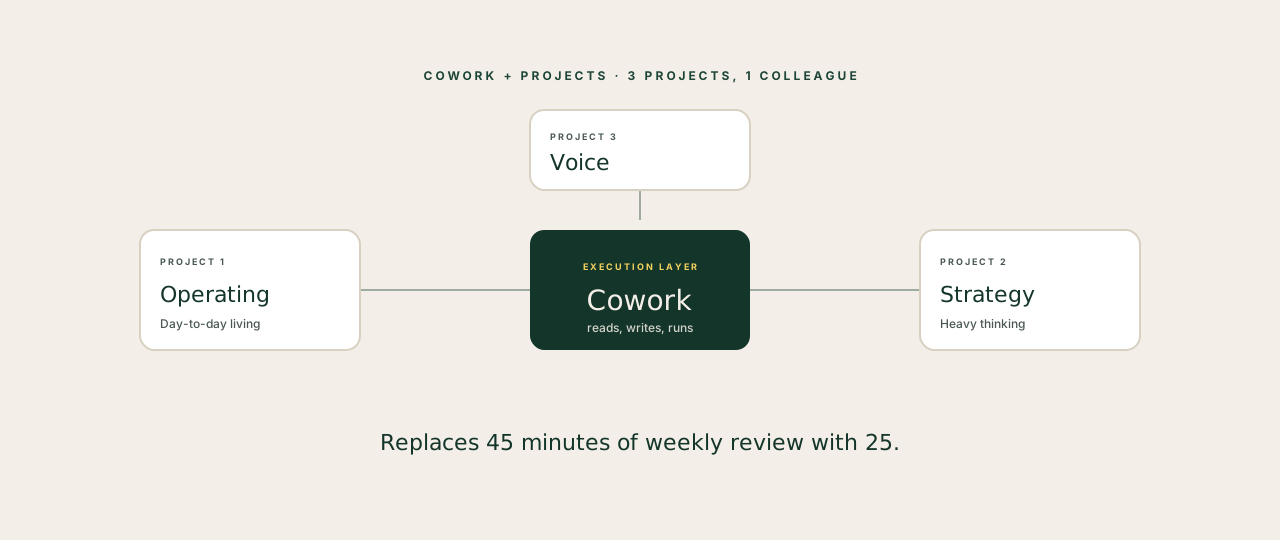
Cowork's job is execution. It reads, writes, edits, runs commands, operates connectors. It is the doing layer. It excels at single sessions where you need work to happen on real files and real apps.
Projects' job is memory. A Project is a container with persistent instructions, persistent files, and persistent conversation history. You pin the things Claude should know about your work. Every conversation inside that Project starts with that context already loaded. The Project is the knowing layer.
The trap most leaders fall into is using Cowork without Projects. Every session is cold. Every prompt has to recreate the world. Setting up two or three Projects ends that.
Cowork without Projects is a brilliant temp who forgets your name overnight. With Projects, it's a chief of staff who's been with you a year.
The three Projects every founder should have running
You can have dozens. You only need three to feel the difference.
1. The Operating Project. Where the day-to-day living happens. Inside it: a one-page overview of your business, your weekly priorities, your team list, your customer list at a high level, your "things I never want to do again" list, and your tone-of-voice spec.
Use this Project for: drafting emails, prepping calls, writing the weekly team update, sketching plans. The persistent context means you stop starting every chat with "I run a B2B SaaS for…"
2. The Strategy Project. Where the heavy thinking happens. Inside it: your most recent board deck, the latest investor update, the financial model, the OKRs, the strategic memos that matter, the competitive teardown.
Use this Project for: pressure-testing a hypothesis, running scenario analysis, writing the next strategic memo, prepping the next board call. Different mode, different memory. Don't mix it with the Operating Project or both get diluted.
3. The Voice Project. Where your writing lives. Inside it: 20 to 30 examples of you at your best (LinkedIn posts, blog drafts, key emails, talks), plus a one-page voice spec ("direct, British, never use these words, here are five sentences I'd write and five I'd never write").
Use this Project for: any first draft. Cowork can do brilliant prose in your voice if it has the corpus to learn from. Without the Voice Project, every first draft sounds like a generic AI. With it, the drafts come back nine-tenths there.
Wiring Cowork to Projects
The mental model: Cowork is the verb, Projects is the noun.
When you start a session, pick the Project first. Then the Cowork capabilities (file access, connectors, Skills) operate within that context. Cowork still has its full power. It just knows who you are and what you're working on.
Practical setup, in order:
- Create the three Projects above. Empty for now.
- Spend 15 minutes per Project filling it with the source material. The Operating Project gets your business overview and team list. The Strategy Project gets the deck and model. The Voice Project gets the writing samples.
- Write a short instructions paragraph at the top of each Project. Five sentences max. What it's for, what's in it, how Claude should behave when working inside it.
- Use the right Project for each session. Don't mix.
The weekly cadence that replaces your review
Most founders run some version of a weekly review. It usually involves a notebook, a list of open loops, a feeling of catching up, and 45 minutes you wish you didn't need.
The Cowork plus Projects version replaces it.
Sunday evening (10 minutes). Open the Operating Project. Ask Cowork to scan the last week's emails, calendar, and key Slack channels and write a "what landed, what's open, what to expect Monday" summary. Save it to your briefings folder.
Monday morning (5 minutes). Read it over coffee. Decide what to keep, what to drop. Tell Cowork to schedule the three things that matter and remind you of them in the right hour.
Friday afternoon (10 minutes). Open the Strategy Project. Ask Cowork to compare the week's priorities against the OKRs. Where did you make progress? Where did you drift? One paragraph each. Save it to /reviews.
Twenty-five minutes a week, replacing the 45-minute weekly review and most of the open-loops-in-a-notebook system. The compounding effect: you stop carrying mental load you can offload.
The mistake to avoid
Putting too much into a single Project. Founders sometimes create one mega-Project with everything in it: business, strategy, voice, customer data, finances. The result: Cowork is overwhelmed, the responses get bland, and the persistent context becomes noise.
Three to five Projects is the sweet spot. Each one focused. Each one with a clear job. Cross-pollinate by linking files across Projects when you need to. Don't merge them.
What this unlocks
The shift is hard to feel until you've lived it for a fortnight. After that, opening Cowork without a Project feels like reaching for your laptop with no charger. You'll find yourself adding fresh context to the right Project as you go, the way you'd add to a notebook. The colleague metaphor stops being a metaphor.
That's when AI stops being a tool and starts being part of how you actually run.